BGCI Education Blog

We've set up this blog to talk about education, the environment, plants, the universe... oh yes, and botanic gardens. You can join in by leaving comments and signing up for email updates.
Showing posts with label BGCI. Show all posts

Sunday, 13 January 2008

Mini Madagascar and plants in the zoo


A little while ago I received a package from Roger Graf, the head of education at Zurich Zoo. He had read the issue of Roots on Botanic Gardens and Zoos (Roots 1:2 Botanic gardens and zoos; synergies for the future) and was interested in the role that zoos and zoo educators can, and do, play for plant conservation. He sent me the very attractive and interesting guidebook to their new Masoala Rainforest exhibition, a partnership project between Zurich Zoo and the Parc National Masoala in Madagascar, a real hotspot for biodiversity.


The guidebook is extremely attractive, with fold out maps of the exhibition and the area of Madagascar it is based on, information about the national park, rainforests and the conservation issues facing the country, plus details on the development of the new exhibition. The main body of the guide is on the plants of the rainforest - illustrated within the exhibition. Each species has a lovely illustration, description including physiological, evolutionary, historical and ethnobotanical information and portrait including range, relatives and economic utility. There are numerous colour photos throughout, with text boxes describing recipes and cultural details to bring the rainforest to life.


Further sections describe the animal exhibits within the mini Masoala Rainforest and outline what can be done to help conserve the rainforest.


The book is a lovely example of how a guidebook can be extended, to provide so much more than information about a given exhibition, but become an introduction to an ecosystem, its importance and threats and the organisms within it. More information about Zurich's Masoala Rainforest can be found on their website and the guidebook can be ordered through their online shop.

Tuesday, 8 January 2008

Encyclopedia of Life coming to life

Suzanne Sharrock, BGCI's director of global programmes, went to an interesting meeting last week in Washington, US. BGCI is a member of the institutional council of a new, very ambitious, project called the Encyclopedia of Life. They are aiming, in association with a huge number of museums, experts, databases etc (including Wikipedia) to create a comprehensive database of every species on the face of the planet.


They say "the Encyclopedia will serve as an online reference source and database for every one of the 1.8 million species that are named and known on this planet, as well as all those later discovered and described. Encyclopedia of Life will be used as both a teaching and a learning tool, helping scientists, educators, students, and the community at large gain a better understanding of this planet and all who inhabit it."


They estimate that the initial sections (I think they are starting with fish) will be available in 2008, and the whole thing will be ready in ten years. It looks like an awesome project - they have a good Q and A section if, like me, you are wondering how on earth they are going to get so many groups to share their carefully gathered and hoarded data for no money. There are also some demonstration pages - I like the way you can select what level of user you are, i.e. novice to expert. They are planning to include a huge amount of data - it sounds really exciting and was inspired by the king of biodiversity, EO Wilson.


Do have a look at the video they have produced -it is really good.

Before waxing too lyrical about it, I do wonder about a couple of points...

- why is so much money being invested in a database when the species being listed are disappearing at such a fast rate?

- would the money have been put to better use carrying out conservation on the ground in some of the most biodiverse regions of the world?

- is yet another database of diversity(e.g. Wikispecies, Species2000) needed?

It would be very interesting to hear your views on this - have a look at it and let us know what you think.....

Thursday, 20 December 2007

Quick couple of ideas and resources

We are lucky in that we receive all sorts of interesting resources and materials through the post from our members and colleagues in education sites around the world. A couple that have been sent through this season are...


The Nezahat Gökyiğit Botanic Garden in Istanbul, Turkey have been really busy with their education programmes and provision. They have a super colourful new leaflet about he activities on offer and a fabulous activity book for their younger visitors


Qui a sauve Beni le petit bonobo? - a beautifully illustrated children's book telling the story of the capture and rescue of Beni, a bonobo chimpanzee whose mother is a victim of the bushmeat trade in the Democratic Republic of Congo. Produced to support the ape sanctuary, Lola ya Bonobo (paradise for bonobos in Lingala, the language of Kinshasa) and funded by Awely, an international organisation working to reduce human-animal conflicts in South America, Asia and Africa. The book has also had support from Appenheul Zoo and WAZA.
ISBN 978-2-9528827-0-5


Chicago Botanic Garden's Autumn Bingo is a nice example of a simply-designed, bilingual, fun activity sheet for children visiting the garden. There are stickers attached to the back of each sheet for children to stick on the squares when they find the subjects.


Wednesday, 5 December 2007

UK educators explore the GSPC for themselves

Julia and I were enjoying the autumn sunshine at the annual Botanic Garden Education Network conference last month, along with 63 others from 24 organisations. It was a super conference, always good fun to catch up with the members, but most importantly the focus was on the Global Strategy for Plant Conservation. The keynote speeches were excellent, started off by Peter Wyse Jackson's summary of the how, what, why, where and when of the GSPC, then followed with presentations on each of the five objectives of the GSPC:


Objective 1 of GSPC – Understanding and Documenting Plant Diversity, Trevor Dines, Plantlife


Objective 2 of GSPC – Facilitating harmony, identifying gaps and promoting mobilisation of resources for plant conservation Chris Cheffings, Joint Nature Conservation Committee.


  • Objective 3 of GSPC – the ecosystem approach to the conservation and sustainable use of biodiversity Monique Simmonds, Royal Botanic Gardens, Kew


  • Objective 4 – Piloting targets, developing and implementing the thematic programmes of work of the Convention Jayne Manley, Plantlife.


  • Objective 5 – Building capacity for plant conservation. How are we doing?Deborah Long, Plantlife.

Each presentation provided a very clear summary of what was happening in the UK with the targets of the GSPC, who was doing what, what had been achieved, what was left to do up to and beyond 2010 and what the challenges are. I found it really helpful to gain an understanding of how different organisations and institutions are contributing to the GSPC. It makes it much more tangible when particular actions are gradually achieving the strategy's targets.


I think part of the intangibility of the GSPC for me is that Target 14 lands firmly at the feet of the educators, is huge and cross-cutting for all the other targets as well. We may not ever know if we can or if we have achieved the target, as it is so difficult to measure. However, the workshops at the BGEN conference provided some great ideas of how we can contribute to the other targets through education and communication provision.


One great example was a workshop on alien invasive species by Plantlife International. Did you know that invasives are the second biggest threat to UK biodiversity and the main source of invasives are gardens? Education therefore has vital role to play in convincing anyone who has or uses a garden that there is a problem and they can help. Plantlife have developed a programme on aquatic invasives and have loads of information on their website about invasives in the UK.


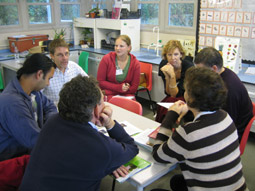
Julia and I also ran a workshop on Target 14 - we wanted to get BGEN members talking about how BGEN can take T14 forward in the UK. We had some great suggestions and ideas. we are still putting the report together, but will post it up on the blog when we have pulled out the main action points. Other workshops covered topics such as teaching about food security, native flora, sustainable procurement and organic gardening. The workshop descriptions and the congress papers are all on the BGEN website, do have a look to see what was discussed.


I really think that this format of conference worked very well to get the network member on board with the GSPC - and would suggest it as a good topic for any network meeting to encourage participation with achieving the GSPC.


There is more on BGEN on the website.

Monday, 3 December 2007

RBG Canada Video

The Royal Botanical Gardens Canada have put up a video about their work.

Wednesday, 17 October 2007

Big Draw


The weather last Saturday was glorious, which was terrific because I spent the day at Kew with family and friends participating in the Big Draw. For those of you who aren’t familiar with this event, it’s a national campaign that aims to get everybody drawing, whether you're three or 93! This year it’s taking place during the month of October with events all over the country. Like many venues, Kew held their Big Draw event on 13 October. If you’re in the UK and want to participate, check out the website for an event near you.

The Big Draw event at Kew tied in superbly with the Henry Moore exhibition they’re currently running. Twenty eight amazing sculptures are sited within Kew’s extraordinary landscape. The day was inspiring, and with so many workshops to choose from it was impossible to go to all of them. As it happened we only managed to get to three! The children really enjoyed the workshop entitled ‘From Nature to Sculpture’. They spent almost an hour looking down the lens of a microscope at tiny seeds and drawing the details on sheets of paper. They then took their recordings outside and made larger pictures using charcoal and these were displayed on a long fence in front of the Orangery, where people were taking lunch and drinking cups of teas and coffee. Incidentally, there was a notable abundance of ladybirds flying around and settling all over the Orangery. There must have been hundreds! It was a spectacular site. I’ve spent time googling about ladybirds but can’t find any answers to why there were so many – if any one’s got an idea, let me know!

Another workshop we participated in, and that was good fun, was ‘Midnight Garden’. The children got to handle some amazing specimens from the Arum family, draw round them on black paper and then cut them out to make a giant frieze. As expected, they chose the largest specimens and then lost heart cutting them out, leaving the parents with aching hands! Nevertheless, they were proud of their contribution and the visual result was terrific as you can see from the pictures. I don’t know how many people came to Kew that day, but certainly visitor numbers were up. The conclusion has to be - art is a fantastic way to engage people in the natural world!

Tuesday, 19 June 2007

GSPC and education

It is warm in the office today. For once we don't have to blame global warming, the UK summer is officially here! Whilst thinking about issues on climate change and other conservation issues facing plant diversity it led me back to the Global Strategy for Plant Conservation, the 16-point plan for saving the world's floral diversity. So inspired, I have been rejuvenating pages on the BGCI education website on the GSPC, and on the Plants 2010 (website of the Global Partnership for Plant Conservation) looking at
- what it is
- what the targets are
- who is involved
- the role of educators in the GSPC
- reports from national consultations on the GSPC

Some of the reports came from consultations arranged by BGCI last year, in China, Brazil, Russia, USA, Indonesia and the UK. These were reported on at the education congress in Oxford in September, and at the congress in Wuhan, China.

Next stop, Julia, BGCI's head of education is off to the Subsidiary Body on Scientific, Technical and Technological Advice meeting in Paris in July to meet and greet and talk to participants about the outcomes of these stakeholder consultations. She'll report on it on her return.

In the meantime, you can also get inspiration on how your own garden is contributing to the GSPC by looking at the website and reading the national and organisational documents connected with it.

Tuesday, 10 April 2007

education for sustainable development - its not just a catchy title

So, we're off to China, to learn, discuss, inspire and gossip....at the 3rd Global Botanic Gardens Congress.

Of course the congress is going to be more than gossiping with friends - the education dept have been set to work! We're running a day long session on education for sustainable development. Hopefully it will be interesting, as its such a varied subject, that some people find very hard to get their head around.

We've had the participants list through though, firstly, its a pretty big workshop, about 28 people, secondly, they are all amazing educators themselves who run some of the best botanic garden education programmes in the world. In fact, lets face it, a decent proportion of them, we were going to use their programmes as case studies for good ESD....

Nevertheless, we shall not be intimidated, we have a few tricks up our collective sleeves. What I find interesting about ESD is just how varied it is - taking in aspects of development education, environmental education, feminism, peace education, ecology , systems thinking, economics and design. It is so much more than learning to appreciate nature - although that is certainly a major part of it. It is recognising oneself within nature, as a portion of the ecosystem, as a biotic part of Gaia, interconnected with all others. Once we can see that our actions, our daily lives have an effect on everything else - we are the butterfly that flaps its wings in Brazil causing a monsoon in India, we can live in a way that reflects this.

So much of ESD is also about critical thinking - is this the best way to live my life, considering I am within this huge system?, is my government making the policy choices that I want them to?, does my botanic garden really contribute to sustainability or is it just lip service?; followed by empowerment - as a citizen of the world I am an individual but I can also make decisions that are important and will make a difference. These skills are also key to the democratic process as a whole, being able to question and also take action, and so are vital for everyone, any age, to have and use.

Our workshop will be looking at the different aspects of ESD, personal meanings, values and beliefs, but also the practical ways that garden education programmes can communicate with their audiences about some of the more abstract concepts. As with any part of CEPA (communication, education and public awareness) programmes, it is all about making it provocative, relevant and revealing new meaning to the audience.

Once we've run it, we will put the workshop on the BGCI website - I want to develop a larger area on the education website focused on ESD, so if you have any ideas or thoughts on the subject, please let me know!

Oh, and if you are interested, the BGCI publication on Education for Sustainable Development: Guidelines for action in Botanic Gardens, is available to download.

Magnolias in danger

Last Monday, BGCI ran an event, in association with Fauna and Flora International to celebrate the publication of the Magnoliaceae red list, basically containing details of the conservation status of the entire Magnolia family. As happens so often with these reports, the outlook identified seems gloomy - the Red List identifies 131 wild magnolias as being in danger of extinction, from a global total of 245 species.

However, at least now we have this data, we know what Magnolias we have, where they are and can now actually do something about it. Knowledge is power after all, and these data are still lacking for many plant families, now we know the story for Magnolia, the situation is clearer. As Sara O said, "There is a strong chance that these species will become extinct unless we take action now," the problems that they face, destruction of habitat and over-exploitation are not impossible to do something about.

The guest list was impressive - great and good from BGCI's board, professors of botany abounded, Fauna and Flora staff and various journos from the scary media world. Plus we had delicious cocktails - yum.

Oh, and vitally , we got some news coverage - to find out more, check out the reports on
BBC
New Scientist
Inthenews

So, though the news might be bleak, the outcome is positive - hopefully through collaborations and working together like this, botanic gardens can and are getting a better idea of what the situation is for plant conservation status and work with the public and governments to address the threats.

Fore more information about the report, and the downloadable red list, have a look at the BGCI website.

Tuesday, 27 March 2007

Green networking

The other day, me and Julia went into sunny London town for an afternoon of interpretation. Malcolm Whitehead, head of learning at the Wildfowl and Wetlands Trust in Barnes, and friend of BGCI, was speaking about the need for interpretation and the pitfalls that face interpreters. he highlighted some of the crucial facts - and foibles about working with interpretation and learning "Could it be that educators are from Mars, curators are from Venus, but each thinks the other is from Uranus...."

The afternoon was set up by the London Parks and Greenspaces forum, with their biodiversity outreach group. I had not come across this network before, but there was a great turn out of people - colleagues from parks, the Environment Agency, museums, wildlife centres, access organisations, science centres and carious consultants and researchers. Speakers included people from the Royal Society for the Protection of Birds (RSPB), Royal Parks and the Sensory Trust.

The presentations were very interesting - the write up is on the BGCI website, but what I was also struck by was the networking. Participants had lunch and coffee together, and the session was followed by a trip to the pub, as it merged with the monthly social meeting of green networks in London, called Beeridiversional. This regular events sees professionals from all aspects of environmental work, ecological consultants, council conservation officers, recycling community workers, fisheries officers, environmental impact assessors, and of course educators from all over the place.

Beeridiversional is in addition to the other London networks - LEEF - London environmental educators forum, BGEN, Botanic Garden Education Network, various teachers groups, green groups and so on. Green networking is the way forward - to share ideas, contacts, experiences and develop partnerships. These days it is really easy to get involved with similar organisations, have a look at BGCI's website page on education links, which includes a section on networks and associations, for more ideas. Or, if there isn't one near you, set up your own - using the Yahoo groups. this is very easy to use - just go to the site, type in what you are looking for and away you go! Typing in 'environmental education' comes up with nearly 800 groups!

We are going to set up an international email 'list serve' for botanic garden educators (as requested from the education survey) in due course, and of course I'll let you know when that happens. Hopefully educators around the world will be able to use it to contact and query each other - using the best resource we have - the expertise of our members!

Friday, 9 February 2007

The tale of a true hummingbird

Last night, BGCI hosted a talk by Professor Wangari Maathai, the women's rights campaigner, founder of the Green Belt Movement and Nobel Peace Prize winner - the first African woman to have been awarded this accolade. And well deserved this accolade is, she is an amazing woman, now in her late sixties, who inspired and motivated the audience at the Royal Geographical Society.

Professor Maathai is a consummate story-teller and throughout her speech I was amazed by the dedication and belief she has in the work she and her organisation are doing, the optimism she displays and the determination which has seen her through many difficult years as a woman's and environmental campaigner in Kenya.

She told us a story - a tale of a courageous hummingbird.

Watch the video on YouTube

The forest it lived in was burning down, the fire was raging through the trees and all the animals in the forest were fleeing for their lives. They stopped at the edge of the forest and watched their home being destroyed, crying and wailing about their misfortune. One tiny hummingbird saw what was happening to her home. So she went to a stream, collected a drop of water in her beak and carried it to the fire. Quick as she could she flew back to the stream and collected another drop, and took it to the fire, and another drop, and another. Quick as she could she collected water and took it to the fire.

The other animals watched her, and called to her 'Stop what you are doing, it is pointless, give up now, you will never be able to change anything, it is too late'. But she wouldn't listen, she kept on collecting drop after drop and taking her tiny amounts of water to the fire. Event eh elephants, with their big trunks, who could suck up a lot of water from the stream, said to her 'Stop this, there is no point, we are lost'. But she still wouldn't listen, and carried on zipping between the stream and the fire. A third time, the other animals watching said 'Don't continue, give up your work'. In between collecting drops of water she turned to them and said 'I may not be able to do very much, but I am trying my hardest - I am doing the very best that I can'.

Professor Maathai turned to the audience and addressed us all saying that we should also be like hummingbirds, it doesn't matter how small or insignificant we feel as individuals when thinking about environmental issues, we should just do the very best we can.

One of the campaigns the Green Belt Movement is involved with at the moment is the Billion Trees Campaign. Again, like the little hummingbird, the idea is that even if only 1 in 6 of us plants a tree, we can still between us all trying our best, plant a billion trees this year - thereby protecting watersheds, preserving soil and creating habitats for many different species.

So, go out today and plant a tree - just make sure you are doing the best you can!

Friday, 2 February 2007

Wise words from Wangari

Things are hotting up in the office. We have an event next week at the rather gorgeous venue that is the Royal Geographical Society with the Nobel Peace Prize winner, Prof Wangari Maathai. We are all very excited about hearing the professor speak. She has a new book out, her autobiography, 'Unbowed' and has come to the UK for the launch. She kindly agreed to speak at a public lecture we have organised as she was unable to be a key note speaker at the education congress last September.

Professor Maathai is an amazing woman, she has worked in the conservation and environment field for many years, leading protests, setting up her NGO 'Green Belt Movement', working with communities, the poor, the oppressed, women's groups and so on, to create a better environment for all. Her work has brought her much acclaim and many accolades in recent years. I think her most powerful message is that one person, one individual, can make a difference to the world and to the environment around them. If we all adopted that attitude we could change the world over-night.

There are still tickets available to hear Prof Maathai speak - have a look on the BGCI website and join us next week
Thursday 8th February 2007
Royal Geographical Society
Doors open at 6.30 - lecture at 7.00

Friday, 22 December 2006

Happy Christmas

So, its the season of festivities and celebrations. Hooray, after the autumn the education department has had, it will be such a relief. First there was the education congress - which was excellent. Check out the reports on the BGCI website and the proceedings if you didn't get to it yourself. Then, there was the International Diploma course in education in botanic gardens - 13 participants from 12 countries. We went everywhere with them, Eden Project, Barnes Wetland Centre, Chelsea Physic Garden, even the Globe theatre.

In the middle of all that I has exams, modules on ecological management and sustainable development - approaches and indicators, for a post graduate certificate in sustainable development. This is a distance learning programme run by Imperial College, London. It ahas been really interesting studying for it - not only the subject, but also to understand how these distance learning courses go. Once a year in the post I receive a pack - a folder, a CD Rom, text books and further reading materials. My course I print out from the CD Rom (I can't read from computer screens, it bugs me) and away I go - 10 hours study per week for 30-odd weeks. I'm sure its more work than I ever did for my Master's degree - and its only a third of a Masters! Then in October I sit one 2-hour exam for each module. I just found out today, I have passed this year's modules- thank goodness!

Its interesting, as there are hundreds of us, studying the same topic, all over the world - but we never meet! There is an on-line discussion and study area, but it is under-used as a resource, I have been too scared to join in the discussions so far - even though I have questions on the materials too.

These are the kinds of things we will have to bear in mind if we decide to progress with the idea of developing a distance learning programme for environmental education - participants at the Education Congress were asked about it, and 70 % said they were interested. We will need a lot of work to develop this further, working in partnership with other capacity building organisation, maybe a university, maybe other botanic gardens, and definitely some funders! But it would be interesting to give it a go, and be more environmentally friendly than sending trainers overseas to run training courses.

What do you think? Would you be interested in participating in a distance learning programme examining environmental education - master planning, evaluation, theory, philosophy, practical aspects, everything you could need to set up your own education centre? What would you want to get out of it and how would you want it to look - on the internet, on CD Rom, on paper...the possibilities are vast!

In the meantime, have a great Christmas if you are celebrating and an engaging New Year. I'm off to the beautiful New Forest for some walking and feasting. Until 2007!

Friday, 8 December 2006

Welcome!

Click the pic to see the people

Hello. Great you're reading our first blog. We've set up this blog to talk about education, the environment, plants, the universe... oh yes, and botanic gardens.


We've just run a fantastic education congress in Oxford. Just look how many people turned up!